Some place names included in The North Carolina Gazetteer contain terms that are considered offensive.
Copyright Notice: This content is from the North Carolina Gazetteer, edited by William S. Powell and Michael Hill. Copyright © 2010 by the University of North Carolina Press. Used by permission of the publisher. For personal use and not for further distribution. Please submit permission requests for other use directly to the publisher.
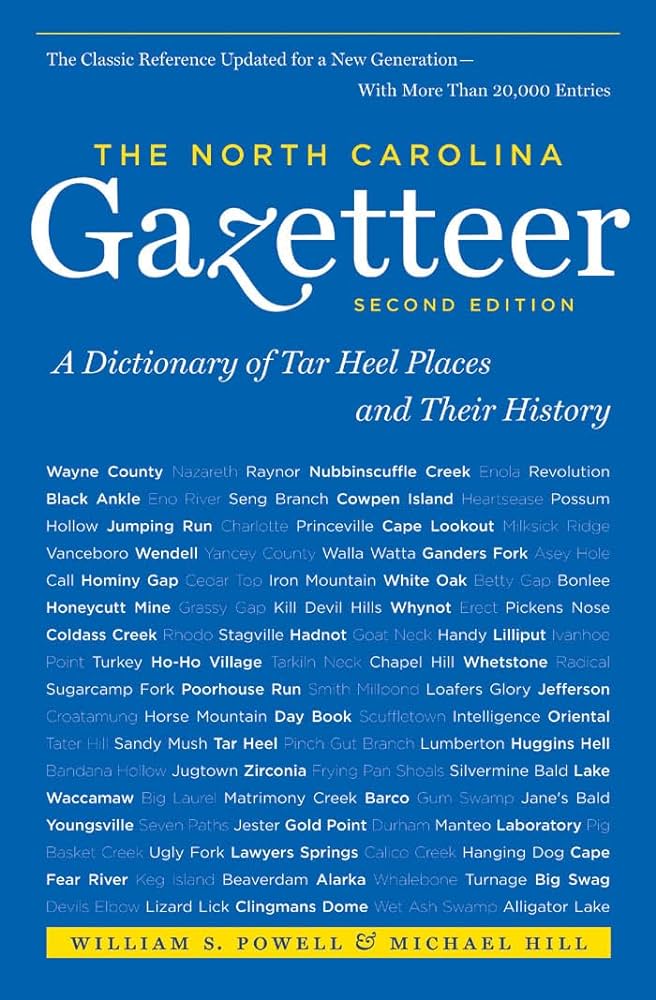
"The North Carolina Gazetteer is a geographical dictionary in which an attempt has been made to list all of the geographic features of the state in one alphabet. It is current, and it is historical as well. Many features and places that no longer exist are included; many towns and counties for which plans were made but which never materialized are also included. Some names appearing on old maps may have been imaginary, but many of them also appear in this gazetteer.
Each entry is located according to the county in which it is found. I have not felt obliged to keep entries uniform. The altitude of a place, the date of incorporation of a city or town, may appear in the beginning of one entry and at the end of another. Some entries may appear more complete than others. I have included whatever information I could find. If there is no comment on the origin or meaning of a name, it is because the information was not available. In some cases, however, resort to an unabridged dictionary may suggest the meaning of many names."
--From The North Carolina Gazetteer, 1st edition, preface by William S. Powell
| Place | Description |
|---|---|
| Brummett Creek |
rises in W Mitchell County and flows SW into Toe River. |
| Brundana |
community in W Mitchell County. |
| Brunswick |
community in N Randolph County served by post office, 1884-1903. |
| Brunswick |
town in central Columbus County. Inc. 1925. |
| Brunswick |
former town in SE Brunswick County on Cape Fear River, now a State Historic Site. A museum contains artifacts, and many building sites have been excavated. Settled about 1725 and est. 1745. Named for King George I, Duke of Brunswick and Lunenberg. First abandoned about 1776, but two or three families moved back after the Revolution. By 1830 the town was totally in ruins. During the Civil War, Fort St. Philip (named for St. Philips Church there but also known as Fort Anderson) was constructed over part of the site. Brunswick was the county seat, 1764-79. Several colonial governors resided there. Modern archaeological work has revealed foundations of 23 of 60 colonial-era structures identified at the site. |
| Brunswick County |
was formed in 1764 from New Hanover and Bladen Counties. In the SE section of the state, it is bounded by the Atlantic Ocean; South Carolina; Columbus, Pender, and New Hanover Counties; and the Cape Fear River. Named for the town of Brunswick, which see. Area: 907 sq. mi. County seat in rural setting near Bolivia. Townships are Lockwood Folly, Northwest, Shallotte, Smithville, Town Creek, and Waccamaw. Produces corn, soybeans, oats, hogs, beef cattle, fishmeal, lumber, fertilizer, hay, tobacco, strawberries, and processed seafood. |
| Brunswick River |
NE Brunswick County, extends S from Cape Fear River along the W side of Eagles Island and empties into Cape Fear River. Approx. 5 mi. long. The waterway undoubtedly is the Hilton's River discovered by William Hilton in 1663 and described by him in an account published the next year. |
| Brush Creek |
rises in central Madison County and flows SE into French Broad River. |
| Brush Creek |
community in SE Randolph County served by post office, 1846-73. |
| Brush Creek |
rises in S Swain County and flows W into Little Tennessee River. |