Orange County [1]
 [2]
[2]
ORANGE COUNTY GOVERNMENT:
www.orangecountync.gov [3]
COUNTY SEAT: Hillsborough
FORMED: 1752
FORMED FROM: Johnston, Bladen, Granville
LAND AREA: 397.96 square miles
2018 POPULATION ESTIMATE: 146,027
White: 76.6%
Black/African American: 11.8%
American Indian: 0.6%
Asian: 8.3%
Pacific Islander: 0.1%
Two or more races: 2.6%
Hispanic/Latino: 8.6% (of any race)
From State & County QuickFacts, US Census Bureau, 2020. [4]
CONGRESSIONAL DISTRICT: 4TH
BIOGRAPHIES FOR [5]
[5]
Orange County [5]
 [6]WILDLIFE PROFILES FOR
Piedmont region [6]
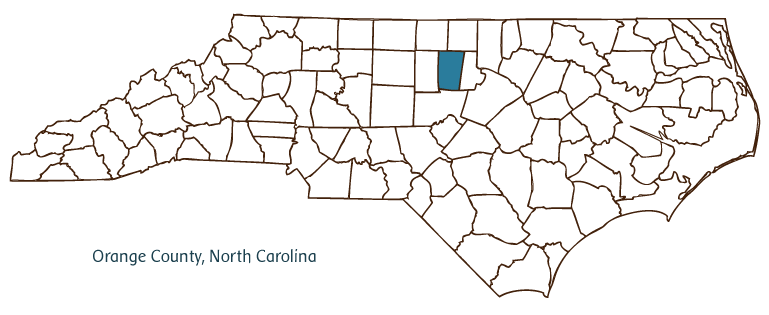
GEOGRAPHIC INFORMATION
REGION: Piedmont [7]
RIVER BASIN: Cape Fear [8], Neuse [9], Map [10]
NEIGHBORING COUNTIES: Alamance [11], Caswell [12], Chatham [13], Durham [14], Person [15]
See also: University of North Carolina at Chapel Hill [17].
Orange County, located in the Piedmont [7] region of North Carolina, was formed in 1752 from Johnston [18], Bladen [19], and Granville [20] Counties and named for William V of Orange, the infant grandson of King George III of England. Early inhabitants of the area included the Eno [21], Occaneechi [22], and Haw Indians. English, German [23], Scotch-Irish [24], and Welsh [25] settlers later populated the region. The village of Occaneechi on the Great Trading Path was visited by explorer John Lawson [26] in 1701. Hillsborough [27], the county seat, was incorporated in 1759 as Childsburgh, named after Attorney General Thomas Childs [28]; in 1766, the name was changed to Hillsborough in honor of Wills Hill, earl of Hillsborough. The town had a central role in the War of the Regulation [29] (1764-71). Hillsborough maintains a substantial historic district with many important properties. Other communities in the county include Chapel Hill [30], Carrboro [31], Cedar Grove, Efland, Caldwell, Carr, and part of Mebane [32]. Notable physical features of Orange County include the Eno River, Couch Mountain, Lake Michael, Turkey Hill Creek, Blackwood Mountain, and Chestnut Ridge.
Orange County is home to the University of North Carolina at Chapel Hill [17], which was chartered in 1789 and is the nation's oldest state university. Many cultural, historic, and educational institutions are associated with the university, including several libraries housing important historical collections, the Carolina Playmakers [33] and Paul Green Theater, the Morehead Planetarium [34], and the Ackland Art Museum [35]. Apart from campus buildings, Chapel Hill's historic structures include the Horace Williams House [36] and the Episcopal Chapel of the Cross. Non-university-related cultural institutions in Orange County include the ArtsCenter [37] in Carrboro and the Jewish Heritage Foundation [38]. Orange County hosts several popular annual events, such as the Festifall street fair in Chapel Hill, Hillsborough Hog Day, the Hillsborough Candlelight Christmas Tour, and the Occaneechi-Saponi Spring Festival and Pow Wow.
Orange County agricultural commodities include corn, tobacco [39], dairy products [40], berries, horses, sheep, and swine [41]. Manufactured goods from the county include food products, tobacco products, rubber, chemicals, paper, apparel, and furniture. Topaz, hematite, granite, and clay are mined in the county. As part of the thriving Triangle area, Orange County continues to move toward greater urbanization. The county's estimated population in 2004 was 120,900.
Annotated history of Orange County's formation:
For an annotated history of the county's formation, with the laws affecting the county, boundary lines and changes, and other origin information, visit these references in The Formation of the North Carolina Counties (Corbitt, 2000), available online at North Carolina Digital Collections (note, there may be additional items of interest for the county not listed here):
County formation history: https://digital.ncdcr.gov/Documents/Detail/the-formation-of-the-north-ca... [42]
Index entry for the county: https://digital.ncdcr.gov/Documents/Detail/the-formation-of-the-north-ca... [43]
Correction to this entry: William V of Orange was the grandson on King George II of England. His mother, Anne, was the daughter of George II of England and wife of William IV, Prince of Orange, the stadtholder of the provinces of the Northern Netherlands. William V of Orange became the last Stadholdter of the Dutch Republic.
Additionally, while we do not find any surviving records of the attribution of the naming of Orange County, it may be that the county was named for William of Orange, who became William III of England in 1689 in the "Glorious Revolution," in the overthrow of James II.
--Kelly Agan, North Carolina Government & Heritage Library, 2018
Additional resources:
Corbitt, David Leroy. 2000. The formation of the North Carolina counties, 1663-1943. https://digital.ncdcr.gov/Documents/Detail/the-formation-of-the-north-carolina-counties-1663-1943/3692099?item=4553389 [44] (accessed June 20, 2017).
Orange County Government: https://www.orangecountync.gov/ [2]
Hillsborough/Orange County Chamber of Commerce: https://www.hillsboroughchamber.com/ [45]
DigitalNC, Orange County: https://www.digitalnc.org/counties/orange-county/ [46]
North Carolina Digital Collections (explore by place, time period, format): https://digital.ncdcr.gov [47]
Image credits:
Rudersdorf, Amy. 2010. "NC County Maps." Government & Heritage Library, State Library of North Carolina.
1 January 2006 | Powell, William S.