March 28, 1849 - March 31, 1904
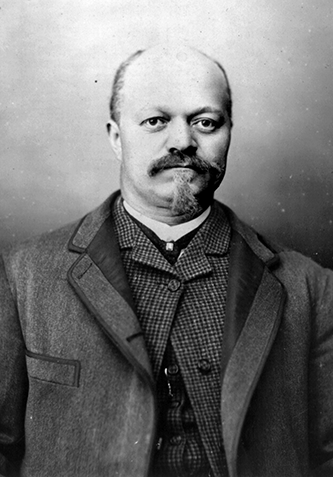
Warren Clay Coleman was merchant, businessman, manufacturer, real estate investor, and housing developer. He also operated the first African-American-owned and operated textile mill, Coleman Manufacturing Company.
He was born into slavery as the son of Roxanna "Roxie" Coleman, a woman enslaved by Daniel Coleman, Sr., of Concord, and Rufus Clay Barringer. Roxie later married John F. Young, an enslaved man and blacksmith. Often, when enslaved people married, the man's enslaver purchased the woman from her enslaver. Contrary to this usual practice, Roxie's husband was enslaved on the Coleman estate following their marriage, and Roxie and John's family, including Warren, remained there as a unit.
Coleman's first twenty-one years were consumed by enslavement, farm work, and apprenticeship that constrained his highly motivated personality. During the Civil War, he worked for the Confederacy, making boots and shoes. Following emancipation, he was bound to William M. Coleman, a Cabarrus planter and lawyer who later became North Carolina's attorney general. Coleman educated and trained young Warren until March 28, 1870, when Warren was released. Warren went to Alabama for a year to seek economic opportunity. He returned to Concord in 1871 and began his business career, starting as a collector of rags, bones, and "junk" but quickly becoming one of Concord's richest merchants. From 1873 to 1874, he attended Howard University as a student in the Model School, preparing himself for business opportunities.
Coleman's first business was a combination barber shop and cake-and-candy store. Reportedly with Rufus Barringer's guidance, Coleman bought land in areas of Concord with many Black landowners, where he often then built rental houses. Between 1875 and 1904, he developed nearly 100 rental properties and purchased four farms and a substantial number of city lots, thereby becoming one of Cabarrus County's largest property owners and most influential citizens.
On December 30, 1873, Coleman married Jane E. Jones, daughter of Joseph and Caroline Loyd of Alabama. On Warren and Jane Coleman's marriage certificate, both are identified as "yellow."
In 1879, Coleman combined his two shops into a large general store that became one of Concord's major retail establishments. Some have described him as a proud and frugal man. He was active in local and state-wide organizations, especially those dedicated to North Carolina's Black community. He was a member of the North Carolina Industrial Association, an African American group seeking to develop African American-owned businesses, and a long-time advocate for the North Carolina Colored Industrial Association Fair. He served as the North Carolina Industrial Association's vice-president, treasurer, and president.
His success was not without challenges, however. He experienced many challenges, including his business burning down three times without fire insurance, the last time being in September of 1885.
By 1895, Coleman was considered one of the South's richest African Americans. He helped found the National Negro Protective Association and championed Black Education, including at Howard University, Livingstone College, and Shaw University. He also supported the North Carolina Oxford Orphans' Home, and aided Professor R. M. Alexander in developing the Coleman School in Welford, S.C. His philanthropy extended to the Zion Hill Church and Price Memorial Temple in Concord.
In mid-June 1896, Coleman tested the climate for an African American-owned mill. Prominent white textile leaders, spearheaded by Washington Duke, were supportive of the concept. Coleman initially sought to raise $50,00 in stock subscriptions from Black investors, but they were unable to raise the capital needed for such a venture. Instead, Coleman chose to borrow from the Duke family in order to fund the mill.
In February 1897, Coleman announced that he would open the first Black-owned cotton mill in the United States. The cornerstone for his Coleman Manufacturing Company was laid in February of 1898, and the mill began production in June 1901. Coleman Manufacturing was the nation's first African American-owned and operated textile factory.
Initially, Coleman Manufacturing Company enjoyed some success, but financial frailties and external market conditions overwhelmed the mill. The mill was underfinanced and opened with secondhand machinery, both of which proved detrimental to the business. In December of 1903, Coleman resigned as director of the mill.
Only three months after the closing of the mill, Warren Coleman died suddenly on March 31, 1904, at the age of 55 in Concord. His cause of death is unrecorded. Coleman was buried in a graveyard that he and other trustees of the Zion Hill AME Zion Church began when they acquired the 17 acres that now comprise Concord's Old Campground Cemetery.
Dr. W.H. Goler, President of Livingstone College, led Coleman's funeral, which was well-attended.
Coleman's mother, Roxie Young, died three weeks later on April 24, 1906. His wife, Jane E. Coleman, died two years later at the age of 70. The couple had no children.
At the time of his death, Coleman owned more than 100 unencumbered houses -- some newspapers reported as many as 350 houses -- and 57 parcels of land across the North Carolina piedmont. Forty-nine of these parcels were in Cabarrus County, with additional properties located in Rowan, Union, Forsyth, Guilford, and Stanly Counties.