State Government
North Carolina State Government
See also: History of NC Constitutions [1]
The text of the NC Constitution [2] may be found on the NC General Assembly Web site.
North Carolina government has three branches:
Executive branch
Executive Branch
Excerpted from the 2001-2002 North Carolina Manual [6]. Updated by: Steven Case, Government & Heritage Library, 2009, 2013; Kelly Agan, Government & Heritage Library, 2014, 2015, 2016, 2017, 2018, 2019, 2020, 2021.
In a move to greatly reduce the number of agencies that had developed in North Carolina government, the Executive Organization Acts [7] of 1971 and 1973 grouped all of the agencies of the Executive Branch into departments plus the Office of the Governor and the Office of the Lieutenant Governor. Since that time, agencies have been renamed and reorganized numerous times. Effective January 1, 2012, the Departments of Correction, Crime Control and Public Safety, and Juvenile Justice and Delinquency were merged into one Department of Public Safety [8].
Ten members of the executive branch are popularly elected. This includes the Governor, the Lieutenant Governor, the Secretary of State, the State Treasurer, and the State Auditor [9]. The departments of the executive branch that have elected department heads are Agriculture, Insurance, Justice, Labor, and Public Instruction. The remaining department heads are appointed by the governor.
Governor [10]: Roy Cooper
Lieutenant Governor [11]: Mark Robinson
Council of State: Elected officials
Attorney General [12]: Josh Stein
Commissioner of Agriculture [13]: Steven W. Troxler
Commissioner of Insurance [14]: Mike Causey
Secretary of State [15]: Elaine F. Marshall
Secretary of Labor [16]: Josh Dobson
State Auditor [17]: Beth A. Wood
State Treasurer [18]: Dale R. Folwell
Superintendant of Public Instruction: [19] Catherine Truitt
Cabinet: Department Secretaries appointed by the Governor
Administration [20]: Machelle Sanders
Commerce [21]: Tony Copeland
Natural and Cultural Resources [22]: D. Reid Wilson
Environmental Quality [23]: Michael Regan
Health and Human Services [24]: Mandy K. Cohen, MD, MPH
Information Technology: Thomas Parrish (Acting)
Public Safety [25]: Erik Hooks
Revenue [26]: Ronald Penny
Transportation [27]: Eric Boyette
Military and Veterans Affairs [28]: Walter Gaskin
Other Executive Officials and Departments
State Budget Director: Charles Perusse
Chief of Staff: Kristi Jones
Director of the Office of State H [29]uman Resources [29]: Barbara Gibson
President of the NC Community College System [30]: Thomas Stith, III
State Agencies
At the time of the Executive Reorganization Acts, there were over 200 independent agencies in state government. Most of these agencies still exist as subdivisions of the executive departments. The location of some agencies may not be obvious--the Division of Veterans Affairs, for instance, is in the Department of Administration. The State Government Portal [31] provides a comprehensive list of state agencies and subdivisions [32].
In addition to the executive departments, there are three independent executive agencies as well as over 50 licensing boards that provide regulatory control for specific occupations. With the exception of the Office of Administrative Hearings, most of the board members are appointed by the Governor; however, some boards are made up of members chosen by multiple parties, including the Governor, the Lieutenant Governor, both houses of the General Assembly, and even Council of State members.
Office of Administrative Hearings [33]
The Office of Administrative Hearings is a quasi-judicial agency that adjudicates administrative law cases (that is, cases in which a plaintiff challenges the application--or lack of application--of a particular agency rule), as well as publishing the NC Administrative Code. The Chief Administrative Law Judge, who serves as Director of the OAH and chooses other Administrative Law Judges, is appointed by the Chief Justice of the NC Supreme Court.
Office of the State Controller [34]
The State Controller is the state's Chief Financial Officer, charged with insuring that State appropriations are expended, accounted for, and reported consistently. The State Controller is appointed by the Governor with the approval of the General Assembly.
State Board of Elections
The State Board of Elections administers the election process and deals with all matters of campaign finance disclosure. Members of the Board are chosen by the Governor.
Occupational Licensing Boards
Occupational Licensing Boards grant certificates of qualification for specific occupations, establish rules of ethics and conduct, and ensure that practitioners adhere to state laws and regulations. Many boards include both practitioners and non-practitioners, who are appointed to represent the public interest.
Educator Resources:
Grade 8: NC Executive Branch – Activity & Poster. North Carolina Civic Education Consortium. http://civics.sites.unc.edu/files/2012/05/ExecutiveBranch.pdf [35]
Grade 8: NC Executive Branch – Activity & Poster. North Carolina Civic Education Consortium. http://database.civics.unc.edu/files/2012/08/ExecutiveBranchPosterChalle... [36]
Your State Government. https://www.nc.gov/government/nc-government [37]
Judicial branch
Judicial Branch
Excerpted from the 2001-2002 North Carolina Manual [6]. Updated by Steven Case, Government & Heritage Library, 2009; Kelly Agan, Government & Heritage Library 2014, 2016
See also: Supreme Court of North Carolina [42]
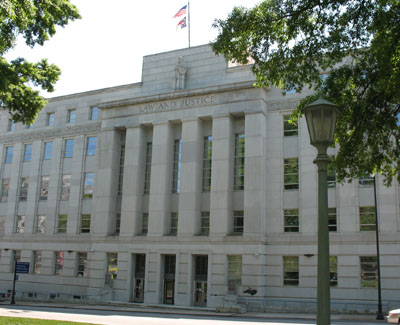 Article IV of the North Carolina Constitution [43] establishes the General Court of Justice, which "shall constitute a unified judicial system for purposes of jurisdiction, operation, and administration, and shall consist of an Appellate Division, a Superior Court Division, and a District Court Division." The Constitution also states that the "General Assembly shall have no power to deprive the judicial department of any power or jurisdiction that rightfully pertains to it as a co-ordinate department of the government, nor shall it establish or authorize any courts other than as permitted by this Article."
Appellate Division
The Appellate Division consists of the Supreme Court and the Court of Appeals.
North Carolina Supreme Court [42]
The Supreme Court [44] is the state's highest court. This court has a chief justice and six associate justices, elected to eight-year terms, who hear oral arguments in cases appealed from lower courts. The Supreme Court considers errors in legal procedures or in judicial interpretation of the law. Its case load consists primarily of cases involving questions of constitutional law, legal questions of major significance, and appeals from convictions imposing death sentences in first-degree murder cases.
North Carolina Court of Appeals
The 15-judge Court of Appeals [46], created in 1967, is North Carolina's intermediate appellate court. Like the Supreme Court, the Court of Appeals decides only questions of law. It hears a majority of the appeals originating from the state's trial courts. Judges of the Court of Appeals are elected by popular statewide vote for eight-year terms. A Chief Judge for the Court is designated by the Chief Justice of the Supreme Court. Cases are heard by panels of three judges, with the Chief Judge responsible for assigning members of the Court to the five panels.
Superior Courts
The Superior Courts [47] are the general jurisdiction trial courts for the state. All felony criminal cases, civil cases involving more than $10,000 and misdemeanor, and infraction appeals from District Court are tried in Superior Court. A jury of 12 hears the criminal cases. In the civil cases, juries are often waived. The Superior Court is divided into eight divisions and 46 districts across the state. Judges are elected to 8 year terms, and rotate every six months between the districts within their division.
District Courts
The District Courts [48] handle the vast majority of the trial level cases. They have exclusive jurisdiction over civil cases involving less than $10,000, almost all misdemeanors, probable cause hearings in felony cases, juvenile proceedings, mental health hospital commitments, and domestic relations cases. As of 2006, North Carolina had 41 district court districts, and 239 district court judges, elected to four-year terms.
Administrative Office of the Courts
All North Carolina courts, at whatever level, are overseen by the Administrative Office of the Courts [49] (AOC). The basic responsibility of the AOC is to maintain an effective and efficient court system, supporting the courts through technology, personnel, financial, legal, research and purchasing services. The AOC prepares and administers the court system's budget and currently employs more than 400 people.
References and additional resources:
North Carolina Administrative Office of the Courts. 2008. The North Carolina judicial system. Raleigh: North Carolina Administrative Office of the Courts. http://digitalstatelibnc.cdmhost.com/u?/p249901coll22,20667 [50].
Image credits:
Justice Building, Raleigh, 2010. From the State Library of North Carolina, Raleigh, NC. https://statelibrary.ncdcr.gov/ [51]. This image is in the public domain.
Legislative branch
Legislative Branch
From the North Carolina Manual
The legislative arm of the state is the North Carolina General Assembly [52]. They enact general and local laws that promote the best interests of the state, and establish rules and regulations governing the conduct of the people.
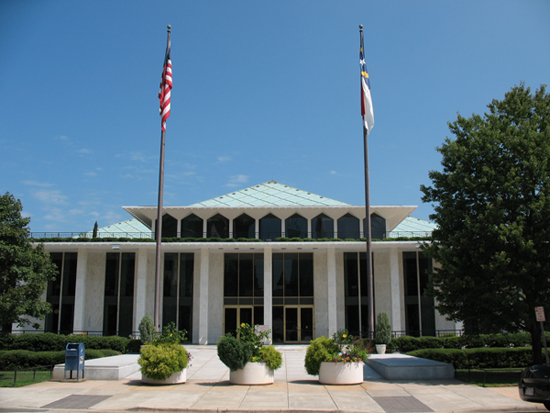
Like the federal government and almost all the other states (Nebraska being the only exception), North Carolina has a bicameral legislature, consisting of two houses: the Senate and the House of Representatives. The legislature meets annually; the so-called "Long Session" occurs in odd numbered years, while the "Short Session" occurs in even numbered years. Occasionally, in the case of a special need, the Governor may call a Special Session of the General Assembly after they have adjourned for the year.
Senate [53]
The Senate has 50 members. Elections for all 50 seats are held every two years. The Lieutenant Governor is the President of the Senate; however, his/her main duty is to cast a deciding vote in the case of a tie. At the beginning of each biennium, the Senate chooses a President pro Tempore, who presides in the absence of the Lieutenant Governor. The most important duty of the President pro Tempore is to appoint the members to the various standing committees in the Senate.
House of Representatives [54]
The House of Representatives has 120 members. Elections for all 120 seats are held every 2 years. At the beginning of each session, the members of the House choose a Speaker, who presides over the business of the House. In extraordinary cases, such as in the 2003-04 biennium, when the house was evenly divided between the two political parties, co-Speakers may be chosen. As in the Senate, the most important duty of the Speaker is to appoint the members to the various standing committees.
Law making [55]
Much of the work of the General Assembly is done by standing committees. These committees consider the bills introduced into the two houses, hold hearings, make such changes and amendments as they think necessary, and report their findings back to their respective chambers. If the report on the final version of the bill is favorable, it comes up for debate on the floor of the House or Senate. After final passage in one chamber, the bill is then sent to the other chamber, where the same events occur. A bill passed by both houses is then sent to the Governor, who may either veto the bill, or sign it into law.
Resources
North Carolina Manual online, Years 2009-2010 and 2011-2012. North Carolina Department of the Secretary of State. https://www.secretary.state.nc.us/Publications/manual.aspx# [56] (accessed April 10, 2015). (Comprehensive resource enumerating North Carolina's state and county governmental structures)
North Carolina Department of the Secretary of State. North Carolina government, 1585-1974 : a narrative and statistical history. Raleigh: North Carolina Department of the Secretary of State. 1975. https://archive.org/details/northcarolinagov1975unse [57] (accessed April 10, 2015). (Includes history of legislators by session year, with index including biographical names)
North Carolina Manual (publication years:1874,1913-2010). Available on Internet Archive. [58]