Lincoln County [1]
 [2]
[2]
LINCOLN COUNTY GOVERNMENT:
www.co.lincoln.nc.us [3]
COUNTY SEAT:Lincolnton
FORMED: 1779
FORMED FROM: Tryon
LAND AREA: 297.94 square miles
2020 POPULATION ESTIMATE: 86,810
White: 91.3%
Black/African American: 5.8%
American Indian: 0.5%
Asian: 0.8%
Pacific Islander: 0.1%
Two or more races: 1.6%
Hispanic/Latino: 7.5% (of any race)
From State & County QuickFacts, US Census Bureau, 2020. [4]
CONGRESSIONAL DISTRICT: 10TH
BIOGRAPHIES FOR [5]
[5]
Lincoln County [5]
 [6]WILDLIFE PROFILES FOR
Piedmont region [6]
GEOGRAPHIC INFORMATION
REGION: Piedmont [7]
RIVER BASIN: Catawba [8], Map [9]
NEIGHBORING COUNTIES: Catawba [10], Cleveland [11], Gaston [12], Iredell [13], Mecklenburg [14]
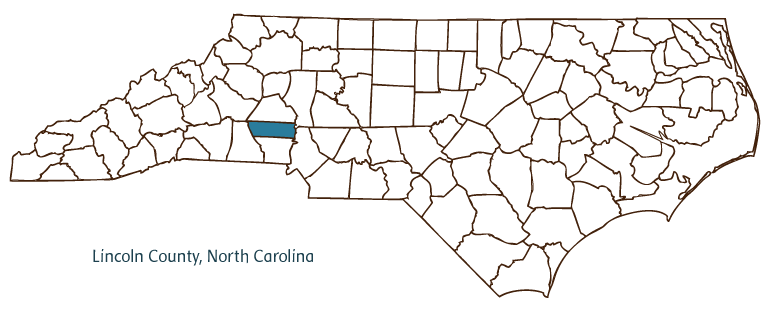
Lincoln County, located in North Carolina's Piedmont [7] region, was formed in 1779 from Tryon County [16], which was subsequently eliminated in an effort to erase the memory of oppressive royal governor William Tryon [17]. Like its seat, Lincolnton [18] (incorporated in 1785), the county takes its name from Revolutionary War general Benjamin Lincoln, who was appointed by George Washington to receive Lord Charles Cornwallis's sword when the British commander surrendered at Yorktown. Other Lincoln County communities include Denver, Triangle, Lowesville, Iron Station, Boger City, Godsonville, Crouse, Reepsville, Vale, and Toluca.
Cherokee [19] and Catawba [20] Indians were the first inhabitants of the area that became Lincoln County. With the westward migration of many North Carolina settlers in the early nineteenth century, the county became one of the most populous and prosperous counties in the state. With ten forges and four furnaces (several of which are still standing), it led the state in the production of iron, and in the early part of the century the Schenk-Warlick Mill [21], the first textile mill in the South, was established within its borders. Farming [22] was also important in the county, with wheat and dairy products among the most lucrative commodities. During the 1840s, however, Lincoln County was greatly reduced in size to form Cleveland [11], Catawba [10], and Gaston [12] Counties; the loss of factories and farmland halted further growth until the establishment of new textile mills and other local businesses during the twentieth century revived the local economy. In the late 1950s and early 1960s, part of Lincoln County's Catawba River [23] was dammed to produce Lake Norman, the largest man-made lake in the state, which provides a steady source of electricity as well as recreational activities. In 2004 Lincoln County's population was estimated to be 68,000.
Annotated history of Lincoln County's formation:
For an annotated history of the county's formation, with the laws affecting the county, boundary lines and changes, and other origin information, visit these references in The Formation of the North Carolina Counties (Corbitt, 2000), available online at North Carolina Digital Collections (note, there may be additional items of interest for the county not listed here):
County formation history: https://digital.ncdcr.gov/Documents/Detail/the-formation-of-the-north-ca... [24]
Index entry for the county: https://digital.ncdcr.gov/Documents/Detail/the-formation-of-the-north-ca... [25]
References:
David C. Heavner, Lincoln County, North Carolina, 1779-1979: Past, Present, Future (1979).
Additional resources:
Corbitt, David Leroy. 2000. The formation of the North Carolina counties, 1663-1943. https://digital.ncdcr.gov/Documents/Detail/the-formation-of-the-north-carolina-counties-1663-1943/3692099?item=4553233 [26] (accessed June 20, 2017).
Lincoln County Government: http://www.lincolncountync.gov/ [2]
Lincolnton-Lincoln County Chamber of Commerce: https://lincolnchambernc.org/ [27]
DigitalNC, Lincoln County: https://www.digitalnc.org/counties/lincoln-county/ [28]
North Carolina Digital Collections (explore by place, time period, format): https://digital.ncdcr.gov [29]
Image credits:
Rudersdorf, Amy. 2010. "NC County Maps." Government & Heritage Library, State Library of North Carolina.
1 January 2006 | Vocci, Robert Blair