Guilford County [1]
 [2]
[2]
GUILFORD COUNTY GOVERNMENT:
https://www.guilfordcountync.gov/ [2]
COUNTY SEAT: Greensboro (courthouse also located in High Point)
FORMED: 1771
FORMED FROM: Rowan, Orange
LAND AREA: 645.70 square miles
2020 POPULATION ESTIMATE: 537,174
White: 56.0%
Black/African American: 35.4%
American Indian: 0.8%
Asian: 5.3%
Pacific Islander: 0.1%
Two or more races: 2.5%
Hispanic/Latino: 8.4% (of any race)
From State & County QuickFacts, US Census Bureau, 2020. [3]
CONGRESSIONAL DISTRICT: 6TH, 13TH
BIOGRAPHIES FOR [4]
[4]
Guilford County [4]
 [5]WILDLIFE PROFILES FOR
Piedmont region [5]
GEOGRAPHIC INFORMATION
REGION: Piedmont [6]
RIVER BASIN: Cape Fear [7], Map [8]
NEIGHBORING COUNTIES: Alamance [9], Davidson [10], Forsyth [11], Randolph [12], Rockingham [13]
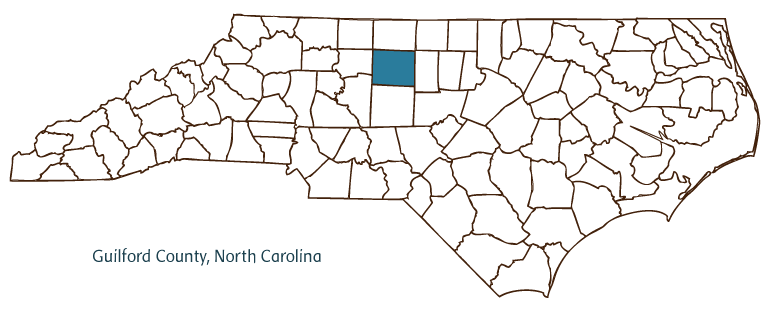
Guilford County, located in North Carolina's Piedmont [6] region, was formed from parts of Orange [20] and Rowan [21] Counties in 1771. It was named after Francis North, first earl of Guilford and father of the prime minister of Great Britain at the time. The county seat moved from Martinsville (originally named Guilford Courthouse) to Greensboro [16], its present location near the geographic center of the county, in 1808. In the early 2000s, Guilford County was the third-most-populous county in the state, with a population estimated at 434,700 in 2004. Greensboro and High Point (the "furniture capital of the world") are its two major cities. Other communities in the county include Jamestown [22], Stokesdale [23], Summerfield [24], Whitsett [25], and parts of Archdale [26] and Gibsonville [27].
Guilford County's history and culture have been among the richest of any North Carolina county. The important Revolutionary War battle at Guilford Courthouse [28], commemorated today by a national military park, took place in March 1781. The city of Greensboro boasts several institutions of higher learning, including Guilford College [29] (1837), Greensboro College (1838), Bennett College [30] (1873), North Carolina Agricultural and Technical State University [31] (1891), and the University of North Carolina at Greensboro [32] (1891). High Point University [33] in High Point was founded in 1924. The sit-ins [17] by four North Carolina A&Tstudents at a downtown Woolworth Store lunch counter in 1960 became a national focal point of the civil rights movement. Institutions dedicated to presenting and interpreting Guilford County history include the Greensboro Historical Museum [34], the Charlotte Hawkins Brown Museum [35] (a North Carolina State Historic Site), the High Point Museum [36], and Mendenhall H [37]omeplace [38] (formerly known as Mendenhall Plantation) a Quaker homestead in Jamestown that dates to 1811.
Throughout its history, Guilford County has depended upon its role as a commercial transportation hub to spark its economy. Greensboro was connected to seven main roads by 1820, and the arrival of the North Carolina Railroad [39] in the 1850s facilitated the shipping of goods through the area. In the wake of the Civil War, Guilford County's attractive combination of low taxes, inexpensive labor, and abundant raw materials such as cotton, timber, and tobacco promoted rapid industrialization. The county continued to thrive throughout the twentieth century, with many corporations such as Jefferson-Pilot, VF, and Lorillard taking up residence. The local economy, long centered around the manufacture of textiles, apparel, and furniture [40], has since greatly diversified (though the International Home Furnishings Market in High Point remains a celebrated and lucrative annual event). Agricultural products include tobacco [41], corn, chickens [42], swine [43], and beef and dairy cattle. Guilford County has also been host to a number of recreational and cultural events, including the North Carolina Shakespeare Festival [44], the Eastern Music Festival [45], the City Stage street festival, the Greater Greensboro Chrysler Classic golf tournament, and the Atlantic Coast Conference [46] and Southern Conference basketball tournaments.
Annotated history of Guilford County's formation:
For an annotated history of the county's formation, with the laws affecting the county, boundary lines and changes, and other origin information, visit these references in The Formation of the North Carolina Counties (Corbitt, 2000), available online at North Carolina Digital Collections (note, there may be additional items of interest for the county not listed here):
County formation history: https://digital.ncdcr.gov/Documents/Detail/the-formation-of-the-north-ca... [47]
Index entry for the county: https://digital.ncdcr.gov/Documents/Detail/the-formation-of-the-north-ca... [48]
References:
Alexander R. Stoesen, Guilford County: A Brief History (1993).
Additional resources:
Corbitt, David Leroy. 2000. The formation of the North Carolina counties, 1663-1943. https://digital.ncdcr.gov/Documents/Detail/the-formation-of-the-north-carolina-counties-1663-1943/3692099?item=4553233 [49] (accessed June 20, 2017).
Guilford County Government: https://www.guilfordcountync.gov/ [2]
Greensboro Chamber of Commerce: https://greensboro.org/ [50]
DigitalNC, Guilford County: https://www.digitalnc.org/counties/guilford-county/ [51]
High Point Chamber of Commerce: https://www.bhpchamber.org/ [52]
North Carolina Digital Collections (explore by place, time period, format): https://digital.ncdcr.gov [53]
Image credits:
Rudersdorf, Amy. 2010. "NC County Maps." Government & Heritage Library, State Library of North Carolina.
1 January 2006 | Vocci, Robert Blair